Celtic animal tattoos
Celtic animal tattoos draw on two real sources: the knotted, interlaced beasts of Insular manuscripts and the animals of Irish and Welsh myth, such as the salmon, stag, raven and hound.
160 designs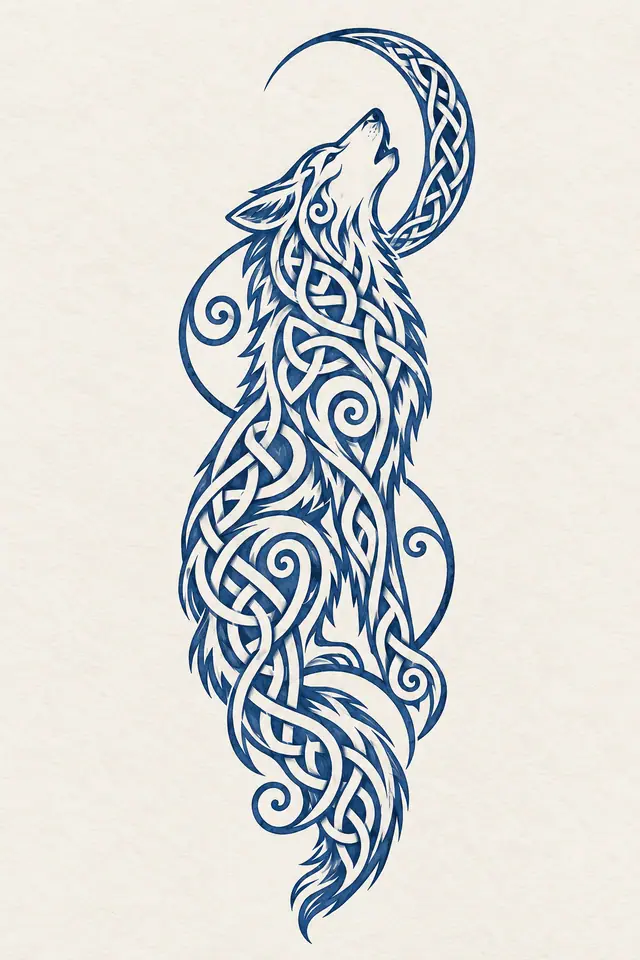
What Celtic animal designs look like
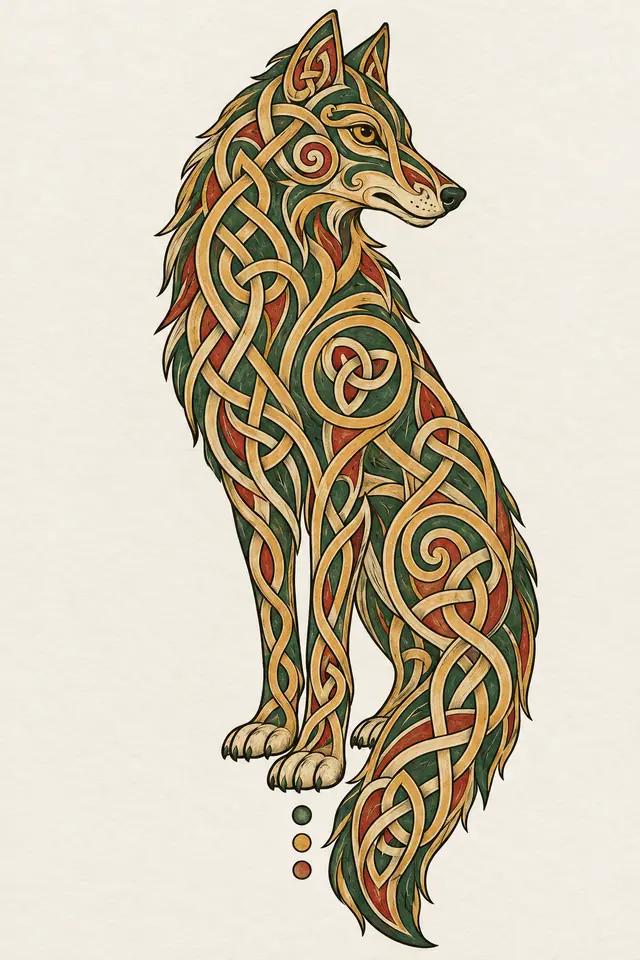
Celtic animal tattoos come in two main styles. The first is zoomorphic interlace: animals whose bodies, legs, tails, tongues or crests stretch into ribbons and tie themselves into knots. This is the style of the Book of Kells (c. 800) and the Lindisfarne Gospels (c. 715), where dogs, birds, lions and serpents weave through the borders and initials. The second is the standalone animal, drawn in a flowing, stylized way with spiral joints and knotwork accents, closer to Pictish stone carving.
Good zoomorphic linework follows the same rules as any Celtic knot: each strand alternates over and under, ribbons stay an even width, and gaps stay open. On top of that, the animal has to stay recognizable. A common trick from the manuscripts is to use spirals for the hip and shoulder joints, which keeps the body readable while the limbs dissolve into knotwork.
Where it actually comes from
Animals run all through Celtic art and myth, but the evidence is scattered, so it pays to keep claims modest.
In art, Insular manuscripts are the main source for zoomorphic interlace. Pictish symbol stones in Scotland show striking animals, including wolves, bulls, boars, eagles and the mysterious “Pictish beast.” Older still, the Gundestrup cauldron, a silver vessel found in a Danish bog and usually dated to the last centuries BC, shows an antlered figure surrounded by animals. That figure is often identified with the god Cernunnos, though the cauldron itself carries no names. In England, the Uffington White Horse, a chalk figure cut into an Oxfordshire hillside, is about 3,000 years old.
In story, animals are everywhere:
| Animal | Where it appears | Common reading |
|---|---|---|
| Salmon | Salmon of Knowledge, eaten by young Fionn mac Cumhaill | Wisdom, insight |
| Stag | Antlered figure on the Gundestrup cauldron; deer in Fionn tales | Nature, renewal, leadership |
| Raven or crow | Form taken by the Morrigan in Irish myth | Fate, war, prophecy |
| Boar | Boar figures in Celtic metalwork; Twrch Trwyth in Welsh myth | Courage, strength, ferocity |
| Hound | Cu Chulainn, “the hound of Culann” | Loyalty, protection |
| Horse | Epona, Gaulish horse goddess; Uffington White Horse | Travel, freedom, sovereignty |
The readings in the last column come from these stories and later folklore. They are reasonable associations, not fixed definitions handed down from ancient times.
As for tattooing: the historian Herodian, writing in Greek, said that Britons marked their bodies with designs of animals, and Julius Caesar described Britons coloring themselves with woad (De Bello Gallico 5.14). Both are tantalizing, but neither proves tattooing over paint, and no tattooed Celtic remains have been found. Our page on ancient Celtic tattoos looks at these sources in full.
What it is commonly taken to mean
Most people choose a Celtic animal for its story. A salmon for someone who values learning, a hound for loyalty, a stag for a love of the outdoors, a raven for someone drawn to the darker side of Irish myth. You’ll also see “Celtic animal zodiac” and “Celtic spirit animal” charts online. These are modern inventions with no basis in early sources. Treat them as fun, not history.
Design choices
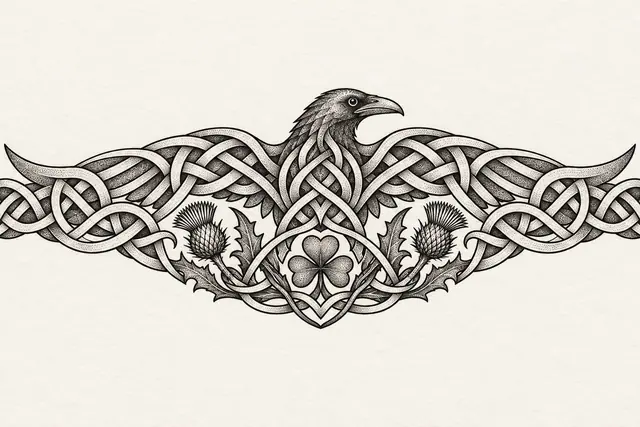
Blackwork zoomorphic interlace looks striking and holds up well, especially for birds and hounds with long knotted bodies.
Illuminated-manuscript color is the most faithful style for manuscript beasts. Yellow, red, green and purple fills, outlined in black, recall the Book of Kells directly.
Dotwork suits Pictish-style animals, mimicking carved stone with stippled shading.
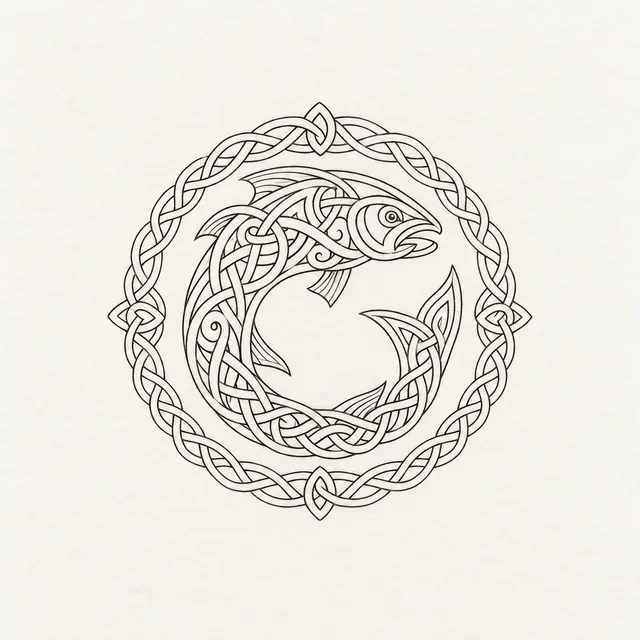
Fine-line works for simple animal outlines, but avoid fine-line zoomorphic interlace unless the piece is large.
Woad-blue single-color animals have an ancestral feel and suit stag and boar designs especially.
Placement and size
- Forearm: 3-5 inches for a single stylized animal, like a salmon along the arm or a raven in profile.
- Upper arm and shoulder: 4-6 inches, suited to a knotted hound or stag.
- Back: large scenes with several animals, or a stag with antlers spreading across the shoulders.
- Sleeve: animals are ideal for sleeves, because long knotted bodies can wrap around the arm and link sections. Browse our sleeve designs.
- Small pieces: stick to a simple silhouette with one or two knotwork accents at around 2 inches.
Animals with long necks or tails, like birds and hounds, flow well around curved areas such as the calf and shoulder cap.
Plan the direction the animal faces, too. A creature that looks toward the center of your body, or forward along a limb, usually reads as more settled than one facing off the edge of the skin. On a forearm, a salmon swimming up toward the elbow looks natural. On the back, two ravens facing each other make a balanced pair.
Pairing it with other symbols
Animals pair naturally with the tree of life, with ravens in the branches or a stag beneath them. A salmon swimming around a triskele echoes the spiral joints of manuscript beasts. Knotwork borders frame any animal well, and the animal’s tail can become the border itself, a classic Insular touch that ties the whole piece together.
Celtic animals tattoo designs
Questions people ask
What do Celtic animal tattoos mean?
Each animal carries associations from myth and later folklore: the salmon with wisdom, the stag with nature and renewal, the raven with fate and war, the hound with loyalty. These links are drawn from stories, not from any ancient chart of tattoo meanings.
Did the ancient Celts have animal tattoos?
We can't say for sure. The Greek-writing historian Herodian mentioned Britons marking their bodies with designs of animals, but whether these were tattoos or paint is unclear, and there is no direct archaeological proof.
What is a Celtic spirit animal?
The idea of a personal Celtic spirit animal or animal zodiac is modern and has no basis in early Irish or Welsh sources. Choosing an animal because its story speaks to you is a better and more honest reason.
How big should a Celtic animal tattoo be?
Simple animal silhouettes can work at 2-3 inches. Zoomorphic interlace, where legs and tails knot together, needs 4 inches or more, and full knotted animals do best on the upper arm, back or as part of a sleeve.
Related symbols
 Celtic knotUnbroken interlace, read today as eternity and connection.
 Trinity knotThree interlocked arcs, best known as the Holy Trinity.
 TriskeleA triple spiral that is older than the Celts themselves.
 Tree of lifeRoots that mirror branches: growth, family and balance.
 Celtic crossThe ringed stone cross of early medieval Ireland.
 CladdaghHands, heart and crown from 17th-century Galway.
 Shield knotA four-cornered knot worn for protection.
 Dara knotA modern knot inspired by the roots of the oak.
 Motherhood knotA modern knot of two hearts, for parent and child.