Triskele tattoos
A triskele tattoo shows three spirals or curved arms turning from one center. The oldest Irish examples, at Newgrange, are Neolithic and predate the Celts by thousands of years.
90 designs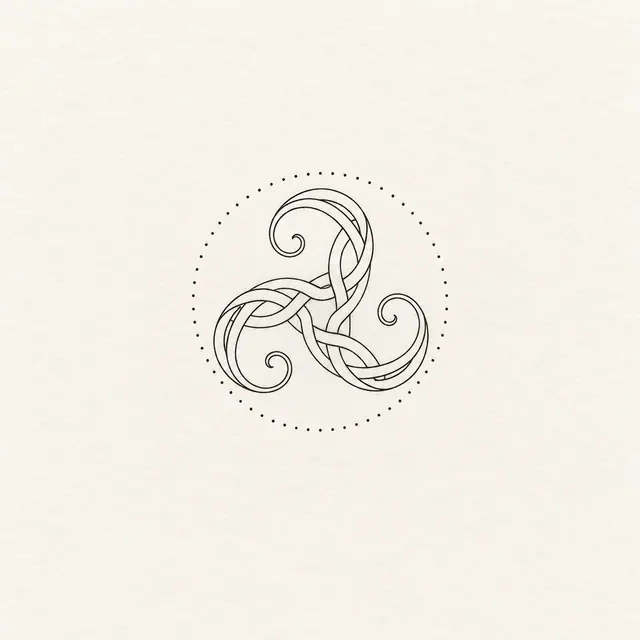
What the triskele is
A triskele (also spelled triskelion) is a motif of three arms rotating around a center. In Irish and Celtic design you’ll mostly see two forms: the triple spiral, where three spirals join into one flowing line, and the three-armed whirl, where curved, often trumpet-shaped arms sweep out from a central point. A third form, three bent human legs, is the emblem of the Isle of Man and Sicily. It shares the name but sits in a different tradition.
Good linework in a triskele comes down to rhythm. The spacing between turns of each spiral should be even, the three arms should match, and the whole design should feel like it’s turning in one direction. Watch the centers closely. Spirals tighten as they wind inward, and that’s where lines get crowded and later blur. A skilled artist will open the center slightly or end the spiral early rather than forcing extra turns into a small space.
Where it actually comes from
The most famous triple spiral is carved inside the passage tomb at Newgrange in County Meath, Ireland. Newgrange was built around 3200 BC, in the Neolithic period. That is older than Stonehenge’s great stones and well over two thousand years earlier than the people usually called Celts. Spirals also cover the huge kerbstone at its entrance. Whoever carved them left no writing, so their original meaning is unknown.
Much later, spirals became central to Celtic art of the La Tene style, from about 450 BC onward. Three-armed whirls and spirals appear on bronze shields, scabbards, brooches and horse gear across Europe and Britain. Spirals then carried on into Christian-era Insular art: the Book of Kells (c. 800) and the Lindisfarne Gospels (c. 715) have pages packed with tightly wound triple spirals.
So the triskele you’d get tattooed today draws on two separate sources: Neolithic stone carving and Iron Age and early medieval Celtic art. Both are real, but they’re not the same culture. And as with every Celtic symbol, there’s no evidence ancient Celts wore it as a tattoo. Our page on ancient Celtic tattoos explains why.
What it is commonly taken to mean
| Reading | Status |
|---|---|
| Motion, progress, moving forward | Popular modern reading |
| Life, death and rebirth | Popular modern reading |
| Land, sea and sky | Popular modern reading |
| Past, present and future | Popular modern reading |
| Sun or solstice symbol (Newgrange) | Speculative; the tomb aligns with the winter solstice sunrise, but the carvings’ meaning is unknown |
| Decorative motif in La Tene and Insular art | Historically attested use |
The Newgrange solstice link is the one you’ll hear most. The tomb really is aligned so that sunlight enters the chamber around the winter solstice. Connecting that to the spiral carvings is a reasonable guess, not a proven fact. If you choose a triskele for growth, change or a family of three, that meaning is yours to give it.
Look closely at photos of the Newgrange carvings and you’ll notice how loose and hand-cut the spirals are. They aren’t mechanically perfect, and some artists like to keep that slight irregularity in a tattoo. Others prefer the compass-precise spirals of later La Tene and manuscript art. Both are authentic choices, so decide which look you want before the stencil is drawn.
Design choices
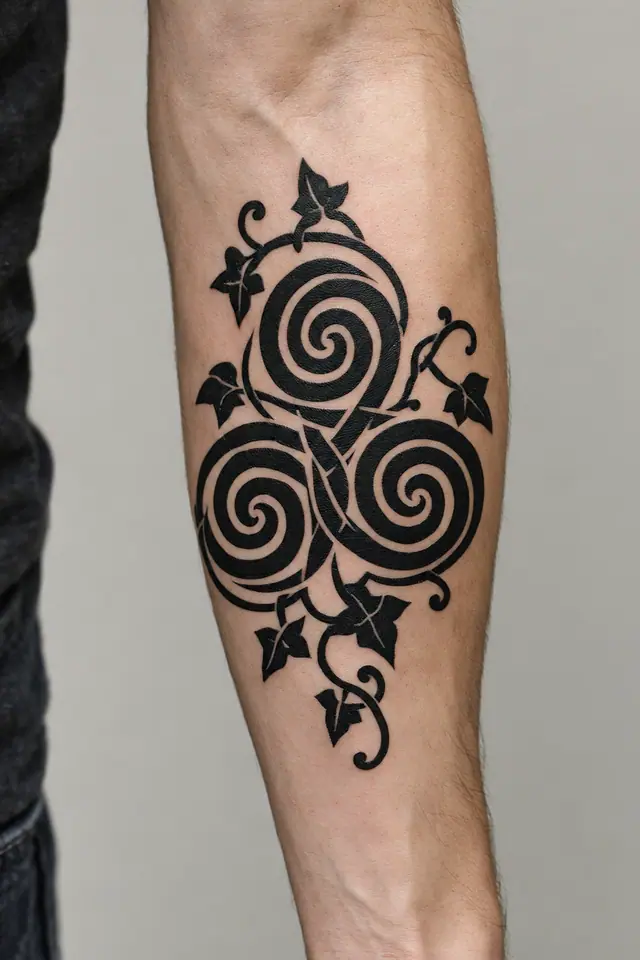
Blackwork spirals with bold lines are faithful to stone carving and age well. Keep line weight consistent from the outer edge to the center.
Fine-line triskeles look graceful, but spirals are where fine lines struggle most. If you go fine-line, limit each spiral to about two turns at small sizes.
Dotwork is a natural fit. Shading the arms with dots, or rendering the whole triskele in stippled texture, echoes the pecked surface of carved stone. See our dotwork designs for examples.
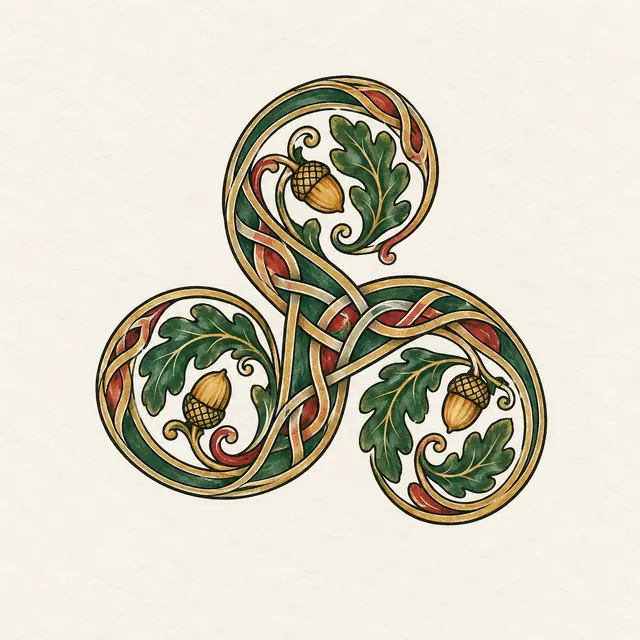
Illuminated-manuscript color suits the Insular style of triple spiral, with yellow, red and green filling the trumpet shapes between spirals.
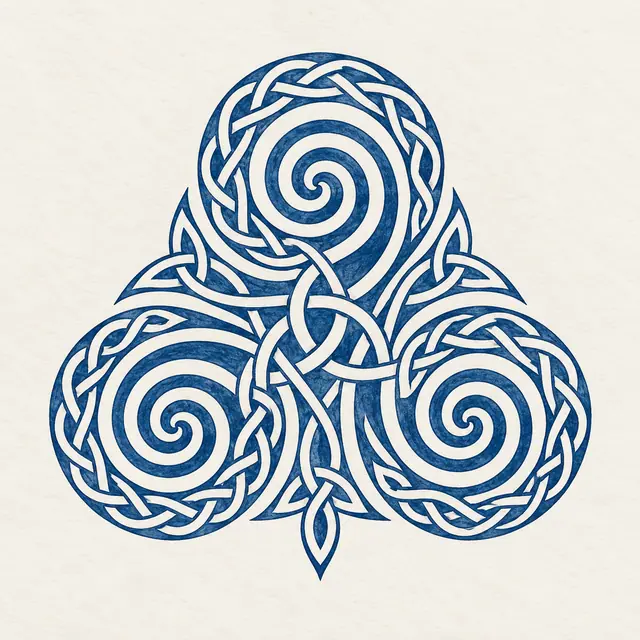
Woad-blue gives a weathered, earthy look and pairs well with stone-texture dotwork.
Placement and size
- Wrist, ankle, behind the ear: a simple three-armed whirl at about 1-1.5 inches. Avoid tightly wound spirals at this size.
- Inner or outer forearm: 2-3 inches allows a true triple spiral with two or three turns per arm.
- Shoulder cap or upper back: 3-5 inches suits a detailed spiral panel or a triskele inside a ring of knotwork.
- Sleeve or back piece: spirals fill awkward spaces well, so they work as connecting elements in larger work.
Spirals tolerate slightly curved surfaces better than strict geometric knots, which makes the triskele good for the shoulder cap and calf. For more on matching symbols to body areas, see our placement guide.
Pairing it with other symbols
The triskele pairs naturally with other three-part symbols, but avoid stacking a triskele and a trinity knot side by side at the same size, since they compete for attention. A better combination is a triskele at the center with knotwork or a plain ring around it. Spirals also pair well with Celtic animal designs, where a spiral can form a hip or shoulder joint, a trick borrowed directly from Insular manuscripts.
Triskele tattoo designs
Questions people ask
What does a triskele tattoo mean?
Popular modern readings include motion and progress, life, death and rebirth, or land, sea and sky. Nobody knows what the Neolithic carvers at Newgrange meant by their spirals, so any meaning you choose is a modern interpretation.
Is the triskele Celtic?
Partly. The famous triple spiral at Newgrange was carved around 3200 BC, long before anyone we call Celtic lived in Ireland. Spirals and three-armed whirls later became a signature of Celtic La Tene art, which is why the symbol is linked with Celtic culture today.
Is a triskele the same as a triquetra?
No. A triskele is built from spirals or curved arms radiating from a center. A triquetra, or trinity knot, is three pointed loops interlaced into a knot. They come from different art traditions and suit different tattoo styles.
How big should a triskele tattoo be?
For spirals with two turns each, aim for at least 1.5 inches across. Tighter spirals with three or more turns need around 3 inches, because the lines crowd together near each center.
Related symbols
 Celtic knotUnbroken interlace, read today as eternity and connection.
 Trinity knotThree interlocked arcs, best known as the Holy Trinity.
 Tree of lifeRoots that mirror branches: growth, family and balance.
 Celtic crossThe ringed stone cross of early medieval Ireland.
 CladdaghHands, heart and crown from 17th-century Galway.
 Shield knotA four-cornered knot worn for protection.
 Dara knotA modern knot inspired by the roots of the oak.
 Motherhood knotA modern knot of two hearts, for parent and child.
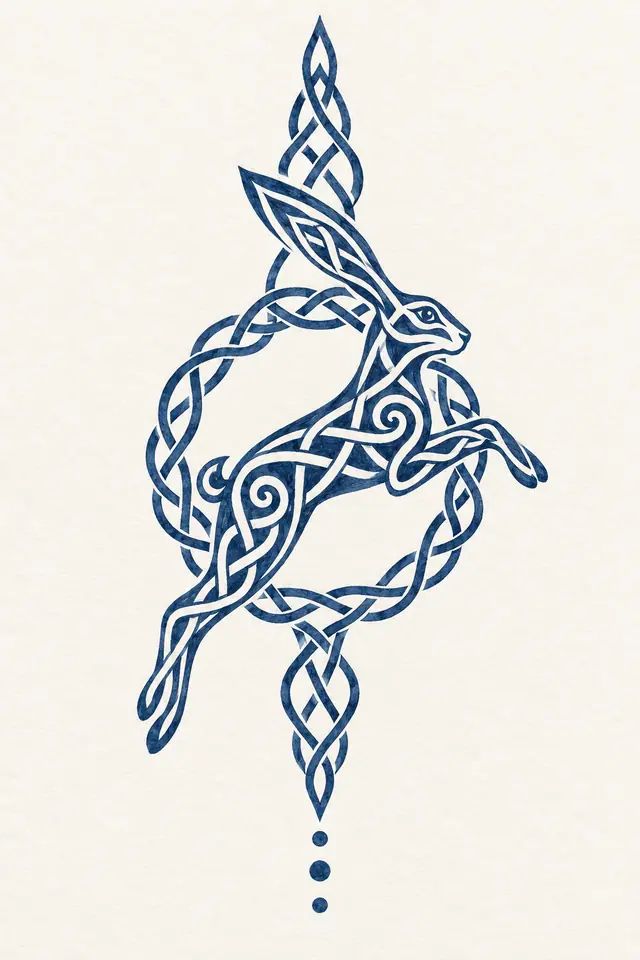 Celtic animalsWolves, stags, ravens and salmon woven into interlace.