Trinity knot tattoos
A trinity knot tattoo, or triquetra, is three interlocked loops drawn as one continuous line. Its best-known meaning is the Christian Holy Trinity; pagan readings are modern interpretations.
124 designs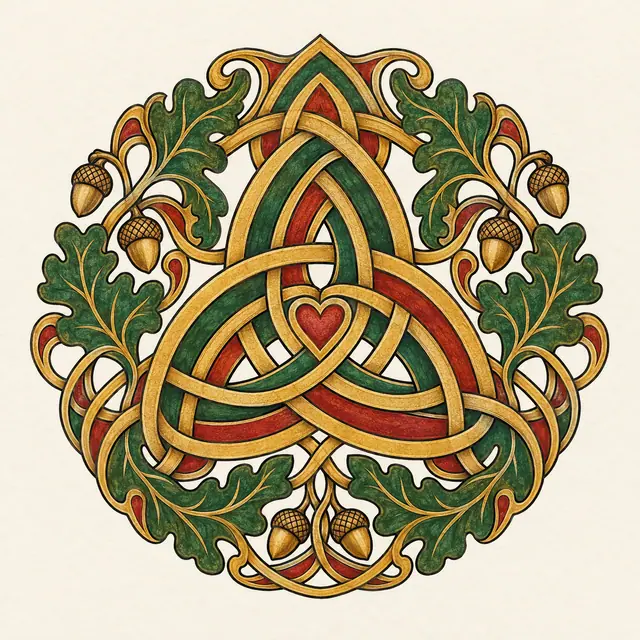
What the trinity knot is
The trinity knot, also called the triquetra (Latin for “three-cornered”), is three pointed loops woven from a single line. A circle often runs through it, interlaced with the loops. It is one of the simplest true knots in Celtic design, which is a big part of why it works so well as a tattoo.
Good linework is easy to judge here because there are so few crossings. Each loop should match the others in size and shape. The three points should sit at equal angles, like the corners of an even triangle. The over-under should alternate cleanly all the way around, and if there is a circle, it should weave through the loops too instead of simply sitting on top. A lopsided triquetra is obvious at a glance, so ask to see the stencil on your skin before your artist starts.
Where it comes from
The triquetra appears in Insular art from Ireland and Britain, including the Book of Kells (c. 800), where small triquetras fill corners and gaps in the decoration. It also shows up on carved stones and church metalwork from the same broad period. Like most Celtic knotwork, its home is Christian-era art of roughly the 7th to 9th centuries.
It is not uniquely Celtic. Very similar three-looped knots appear in Germanic and Norse art, on carved stones and metalwork, and the basic shape is simple enough that it turns up in other places as plain geometry. Many early examples have no circle at all. The ringed version became especially common in modern jewelry and tattoo flash.
You won’t find evidence that ancient Celtic warriors wore it as a tattoo. There is no direct archaeological proof of tattooing among the ancient Celts, and the Roman descriptions of Britons painting or marking themselves never mention knots.
What it is commonly taken to mean
The best-known meaning is Christian: three loops in one unbroken line for the Father, Son and Holy Spirit, three persons in one God. That reading gives the symbol its common English name, and it has the strongest historical footing, because the triquetra is well documented in Christian-era art.
Other readings are popular and modern. Many neopagan and Wiccan writers describe the triquetra as maiden, mother and crone, or as land, sea and sky. These meanings matter to the people who use them, but no early text ties them to pre-Christian Celts. Pop culture helped spread them too: the TV series Charmed (1998-2006) put a triquetra on its book of spells, and plenty of people first met the symbol there.
| Reading | Where it comes from |
|---|---|
| Holy Trinity | Christian, the best-attested reading |
| Past, present and future | Popular modern reading |
| Maiden, mother and crone | Modern neopagan reading |
| Land, sea and sky | Popular modern reading |
| A family or bond of three | Modern personal reading |
None of these is wrong to wear. Just be clear with yourself, and anyone who asks, about which one you mean.
Design choices
Blackwork triquetras with solid ribbons read well from across a room and stay sharp the longest. They are a strong choice for a first tattoo.
Fine-line versions work better here than with most knots, because three crossings leave plenty of open space. A single-needle triquetra can look clean for years if the loops are given room.
Outlined ribbons with an interlaced circle give the classic jewelry look. Keep the gap between the two lines of each ribbon at least 1 mm.
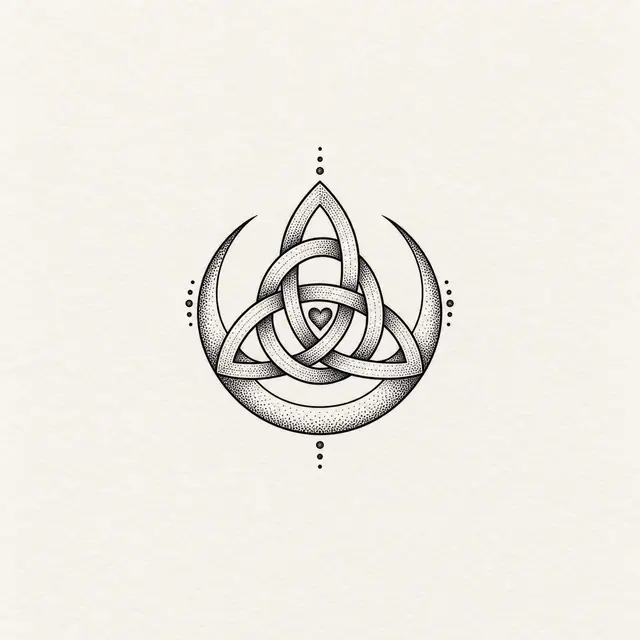
Dotwork shading inside the loops adds depth without the weight of solid black.
Color suits the trinity knot well. A green triquetra is a common nod to Irish heritage, and an illuminated-manuscript palette of red, yellow and blue works at larger sizes.
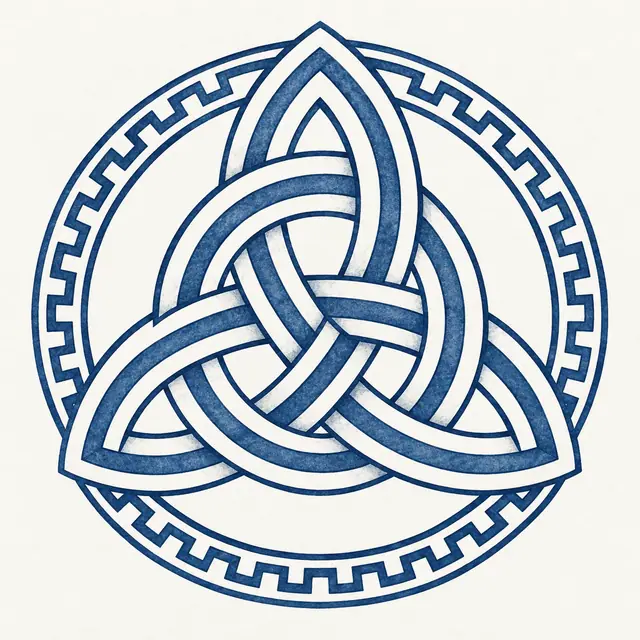
Woad-blue ink gives a soft, old-world feel and pairs nicely with fine-line work.
Placement and size
This is one of the best symbols for small Celtic tattoos. It suits the wrist, behind the ear, the ankle, the inner forearm and the back of the neck.
- Single-line triquetra: about 1 inch (2.5 cm) minimum.
- Outlined ribbons, no circle: about 1-1.25 inches.
- Outlined ribbons with circle: about 1.25-1.5 inches.
- With knotwork border or added detail: 3 inches and up, suited to the upper back, shoulder or chest.
Point the knot so one loop faces up for a stable, balanced look, or one loop down if you like it to read as a shield or heart shape. On the wrist, consider which way it faces when you look down at it versus when someone else looks at it.
Pairing it with other symbols
The triquetra combines easily. A common pairing is a Claddagh heart sitting inside the knot, mixing love and the trinity. Another is a name in Ogham script running along the circle; you can try our Ogham name converter to see how a name looks. Three loops also make natural frames for initials or birth flowers when the design represents a family.
If you like three-part symbols in general, compare it with the triskele, which comes from a much older spiral tradition and gives a looser, more organic feel.
Trinity knot tattoo designs
Questions people ask
What is the difference between a trinity knot and a triskele?
A trinity knot (triquetra) is three pointed loops woven into an interlaced knot. A triskele is three spirals or curved arms turning out from a center, with no over-under weaving. They are often confused, but they come from different art traditions.
Is the trinity knot pagan or Christian?
The best-documented use is Christian, in Insular manuscripts and carvings, where it is read as the Holy Trinity. Similar knots also appear in Germanic and Norse art. Readings like maiden, mother and crone are modern and not attested in early sources.
What does a trinity knot tattoo mean for family?
Many people use it today for a family of three, a couple and their child, or three siblings. That is a personal, modern meaning, and the simple shape makes it easy to add a name or initial inside each loop.
How small can a trinity knot tattoo be?
A single-line triquetra can hold up at around 1 inch (2.5 cm). If you want outlined ribbons or an interlaced circle, go to about 1.25-1.5 inches so the crossings don't close up over time.
Related symbols
 Celtic knotUnbroken interlace, read today as eternity and connection.
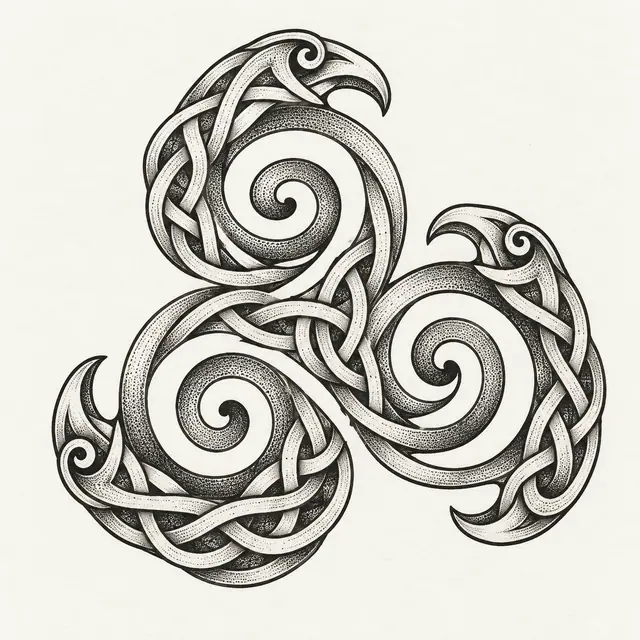 TriskeleA triple spiral that is older than the Celts themselves.
 Tree of lifeRoots that mirror branches: growth, family and balance.
 Celtic crossThe ringed stone cross of early medieval Ireland.
 CladdaghHands, heart and crown from 17th-century Galway.
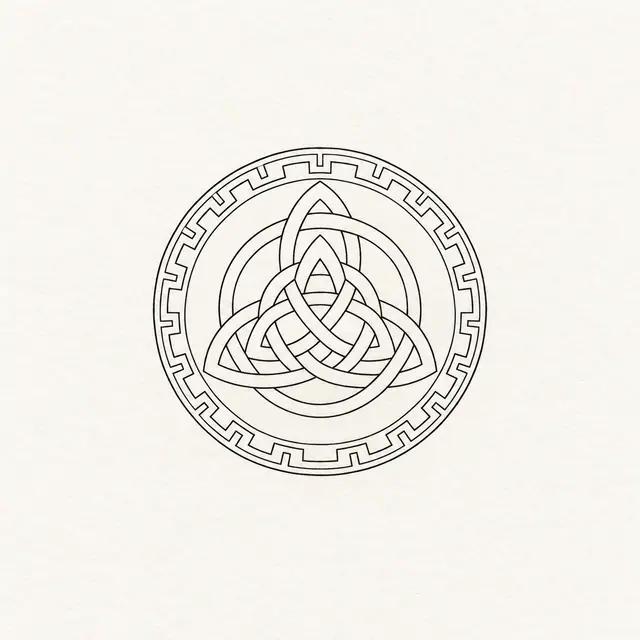 Shield knotA four-cornered knot worn for protection.
 Dara knotA modern knot inspired by the roots of the oak.
 Motherhood knotA modern knot of two hearts, for parent and child.
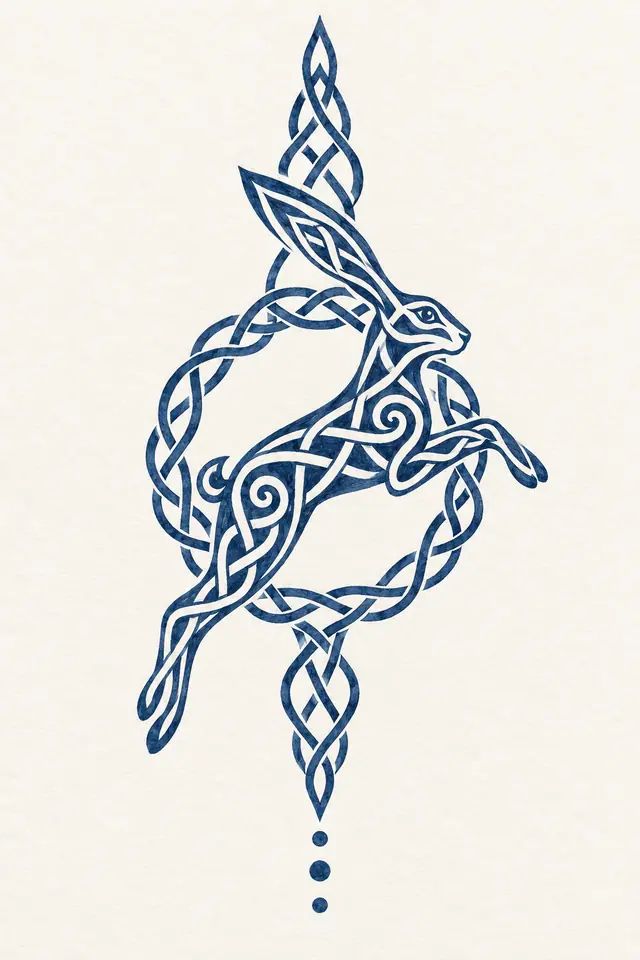 Celtic animalsWolves, stags, ravens and salmon woven into interlace.